Boulder County / Boulder County
Plumber in Boulder, CO
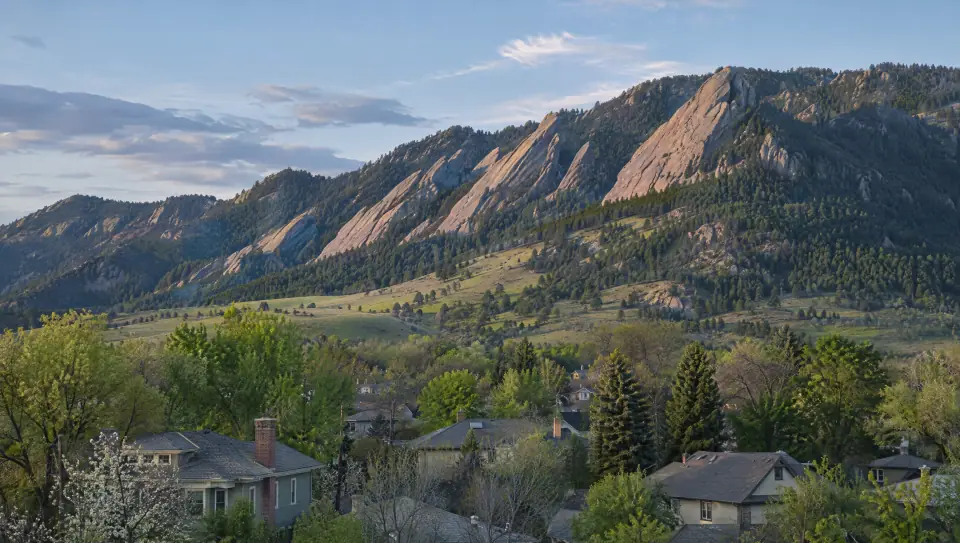
Plumbing repair and replacement for Boulder homes and businesses, from Victorian houses on Mapleton Hill to the postwar ranches of Martin Acres and Table Mesa.
Plumber Denver provides residential and commercial plumbing service in Boulder. As a plumber in Boulder, CO, our work covers drain cleaning, sewer line inspection and repair, leak and pipe repair, water heater replacement, fixture installation and ongoing maintenance. Send us the details through our service request form.
Boulder's housing spans more than a century. The oldest homes sit close to downtown in Mapleton Hill and Whittier. Newlands mixes bungalows with mid-century houses. Martin Acres and Table Mesa came out of the city's postwar growth in the 1950s through the 1970s. Each era brings its own pipe materials, and the public sewer system under the streets has an age problem of its own.
Boulder's clay sewers and the line you own
According to the city, a large portion of Boulder's sanitary sewer system was built from the 1940s through the 1960s, when clay pipe was standard, and those pipes are now reaching the end of their useful life. Boulder is rehabilitating its clay mains by installing a liner inside the old pipe that hardens into a new one, without digging up the street.
That program stops at the main. Boulder homeowners are responsible for the sewer service line from the house up to and including the connection to the city main. A relined main in your street does nothing for a cracked or root-filled lateral in your yard Shifting soil, which the city cites as one cause of cracks in clay pipe, works on private lines too.
If the camera finds trouble, our sewer line repair page explains the options.
Pipe materials by neighborhood era
Most Boulder houses older than a few decades have been re-plumbed in pieces, so the original material and what's actually in the walls can differ. This is where we start the conversation:
| Era | Neighborhoods | What we often find |
|---|---|---|
| Late 1800s and early 1900s | Mapleton Hill, Whittier | Several generations of pipe in one house: cast iron drains, galvanized or copper supply, and joints where different materials meet |
| Bungalow and mid-century | Newlands | Galvanized supply in homes that haven't been updated, cast iron stacks, older laterals under mature street trees |
| 1950s to 1970s | Martin Acres, Table Mesa | Copper or galvanized supply, cast iron drains, and service lines from the same era as the city's clay mains |
Old pipe usually fails at fittings first. A small leak at a transition joint is a leak repair. Repeated leaks or rusty water from corroded galvanized lines usually justify replacing the supply side, which our repiping page covers.
Paperwork that comes with plumbing jobs in Boulder
Boulder's residential repairs permit checklist includes two items that catch homeowners off guard on plumbing projects:
- A Plumbing Fixture Count and Irrigation Form for any plumbing scope that removes, replaces or adds fixtures.
- An asbestos inspection report when the work disturbs potentially asbestos-containing material past set thresholds. One of those thresholds is 50 linear feet of pipe, which can matter in older homes with original pipe insulation.
For water heaters, Colorado's State Plumbing Board reminded local building departments in December 2025 that installation and replacement is plumbing work requiring a licensed plumber, with a permit and inspection by the local authority. If you're replacing a vanity, a toilet or a whole bathroom's worth of fixtures, or swapping a tank for a new water heater, ask early which forms the city will want.
FAQ
Plumbing questions from Boulder
Who is responsible for the sewer line at my Boulder house?
You are, from the house up to and including the connection to the city's sewer main. The city maintains the main itself and is relining many of its older clay mains, but that work doesn't touch private service lines. If your lateral is cracked, sagging or full of roots, repairing it is the property owner's job, even when the city has just rehabilitated the main in your street.
Where does Boulder's drinking water come from?
Most of it starts as snowmelt in Middle and North Boulder Creeks, stored in reservoirs including Barker Reservoir and Silver Lake, then treated at the Betasso plant in the foothills west of town. The rest is Colorado-Big Thompson water from Carter Lake, treated at the Boulder Reservoir Water Treatment Plant. The city's annual drinking water quality report lists the year's test results.
Why does Boulder adjust the pH of its water?
The city adjusts alkalinity and pH at both treatment plants to reduce corrosion in pipes. That protects the city's mains and the plumbing inside your house. If you still see green or blue staining under fixtures, or pinhole leaks in copper pipe, it's worth having the pipe looked at, because the cause is often local to the house, such as old fittings or mixed metals.
Request service
Plumbing service in Boulder.
Tell us what is happening and where. We will confirm the details and set a time.