Seasonal Care / / 5 min read
How to Winterize Outdoor Faucets and Sprinkler Lines on the Front Range
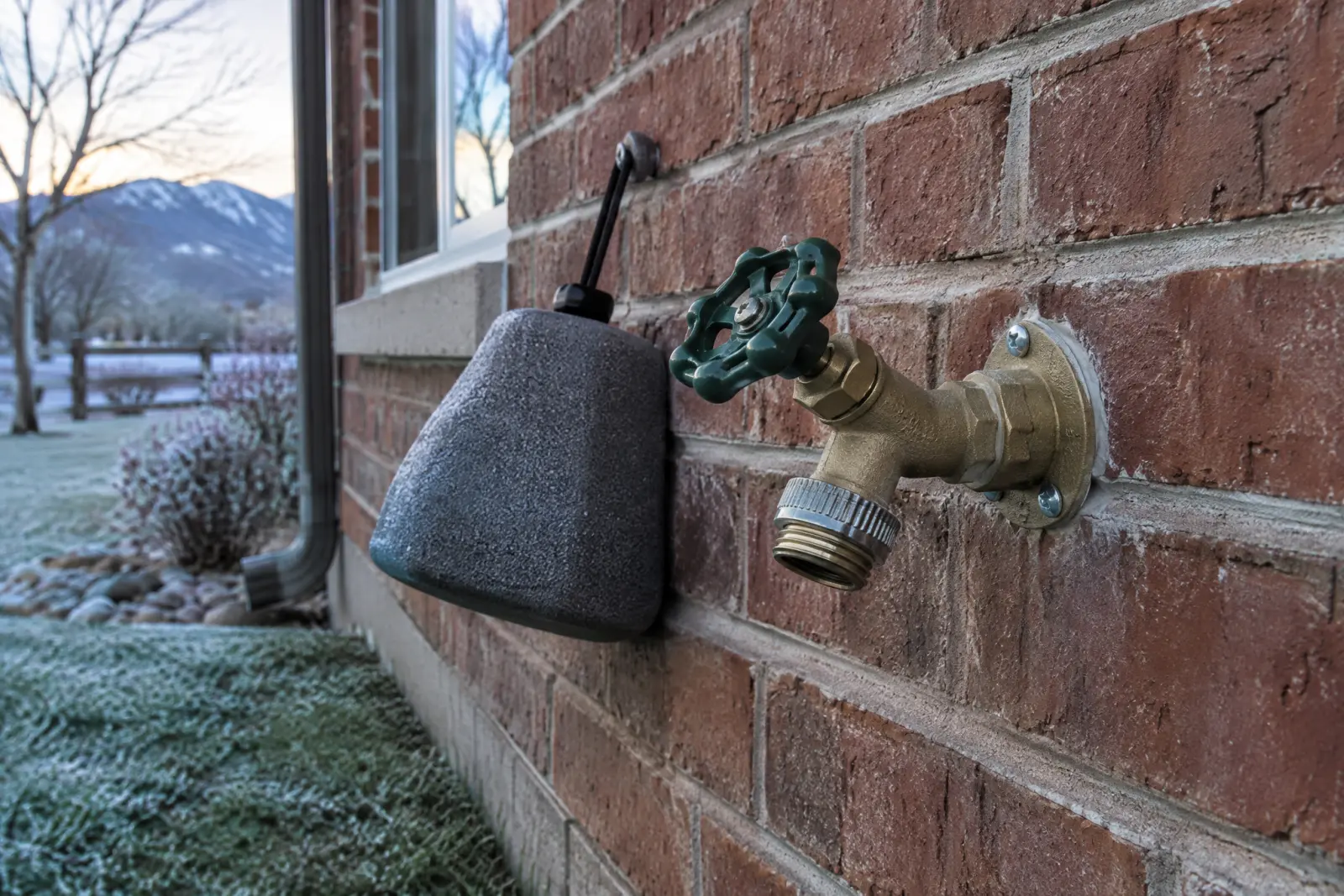
To winterize outdoor faucets and sprinkler lines, you have to do two separate things: stop water from reaching the parts of the system exposed to cold, and get out the water that is already there. Closing a valve does the first. Only draining does the second. By early November most Front Range towns from Colorado Springs to Fort Collins have had freezing nights, and the longer, harder freezes that split un-drained hose bibs and irrigation backflow assemblies tend to arrive this month.
If you did this in October, a second pass is worth ten minutes: a hose reconnected for one warm afternoon undoes the job.
What Cracks When Outdoor Plumbing Freezes
Water expands as it freezes. Inside a closed valve body or a short run of copper, that expansion has nowhere to go, so the metal or plastic gives. A cracked hose bib or backflow body usually doesn't leak in November, because the supply is off or the water is still frozen. It leaks the first time someone opens it in spring, and if the crack is inside the wall, the water goes into the wall cavity or the basement ceiling.
Front Range swings make it worse. A sunny afternoon thaws a fitting, a valve that doesn't fully seat lets water creep back in, and the next night freezes it again.
Standard vs Frost-Free Hose Bibs
Before you shut off outdoor water, know which kind of faucet you have. Older houses and additions often have standard bibs; many newer homes have frost-free ones. Some have both.
| Feature | Standard hose bib | Frost free hose bib |
|---|---|---|
| Where the valve seals | At the outside face of the wall | At the end of a long stem inside the heated wall |
| Water left in the exposed section after closing | The pipe stays full up to the handle | The barrel drains out the spout, if it pitches downward and nothing is attached |
| What winterizing requires | Close the interior shutoff, drain the line, leave the outdoor handle open | Remove the hose and close the handle; an interior shutoff adds a backup |
| Typical freeze failure | Split faucet body or pipe just inside the wall | Split barrel inside the wall, usually from an attached hose or poor pitch |
| Where the damage shows up | Often outside or at the rim joist | Inside the wall or basement ceiling, usually in spring |
From the basement or crawl space, look at the pipe behind the faucet. A long brass tube running through the wall means frost-free. A pipe running straight to the outside wall means standard, and there should be a shutoff valve on that line.
Step-by-Step Checklist to Winterize Outdoor Faucets
- Disconnect everything from every spigot. Hoses, splitters, timers and pressure washer fittings all hold water against the outlet.
- Find every bib. One behind a deck or on a side wall is easy to forget.
- For standard bibs, close the interior shutoff. It's usually in the basement or crawl space near where the pipe leaves the house.
- Drain the line. Open the outdoor faucet, then loosen the drain cap on the interior shutoff over a bucket. Leave the outdoor handle open all winter.
- For frost-free bibs, close the handle and watch the spout. A short drain followed by nothing is what you want. Steady dripping is a problem, covered below.
- Close a backup shutoff if one exists, then reopen the outdoor handle so the barrel stays empty.
- Seal and insulate around the wall penetration. Cold air through a gap at the rim joist can freeze the supply pipe just inside the house, even behind a frost-free bib.
- Add an insulated faucet cover if you want one. It helps, but it doesn't replace draining a standard bib.
Sprinkler Backflow Preventer Winter Shutdown
Many Front Range irrigation systems use a pressure vacuum breaker (PVB): a brass assembly above ground near the house with two ball valves and two small test cocks. Some properties have a reduced pressure zone or double check assembly instead. The goal is the same for each: no supply feeding it and no water trapped inside.
- Shut off the irrigation supply. This is usually a dedicated valve inside the house, sometimes a buried exterior valve that needs a long key.
- Open that valve's drain, if it has one.
- Blow out the zones through a blowout port downstream of the backflow device, never through the device itself. Use the air pressure your system's manufacturer recommends, wear eye protection, and keep clear of the assembly and heads. Hiring an irrigation contractor is reasonable if you don't own a suitable compressor.
- Set the ball valves halfway. Turn both PVB ball valves to about 45 degrees and open the test cocks slightly so water drains from the ball cavities.
- Insulate the assembly, or remove it only if it was installed with unions for that purpose.
- Turn the controller off or to rain mode.
Backflow testing rules vary by water provider and city. Check with yours before replacing or reinstalling an assembly.
If This, Then That: Problems Found While Winterizing
- If a frost-free bib keeps dripping after you close it, the washer or seat is worn. Close its interior shutoff if it has one; if not, have it repaired before a hard freeze.
- If a standard bib has no interior shutoff, nothing isolates it from the cold. Add a shutoff with a drain or replace it with a frost-free bib.
- If a hose was attached during a hard freeze already, remove it, then open the faucet briefly while someone watches the wall or basement ceiling behind it. Water inside means the barrel cracked.
- If the PVB shows a crack, a bulged bonnet or green corrosion at a seam, plan its replacement now rather than at spring startup.
- If the irrigation line refills after shutdown, the supply valve is leaking through; see the call-out above.
If you'd rather have outdoor faucets, interior shutoffs and exposed supply lines checked as part of a seasonal visit, you can arrange that through our plumbing maintenance service. To request service anywhere from Colorado Springs to Fort Collins, use our contact page.